
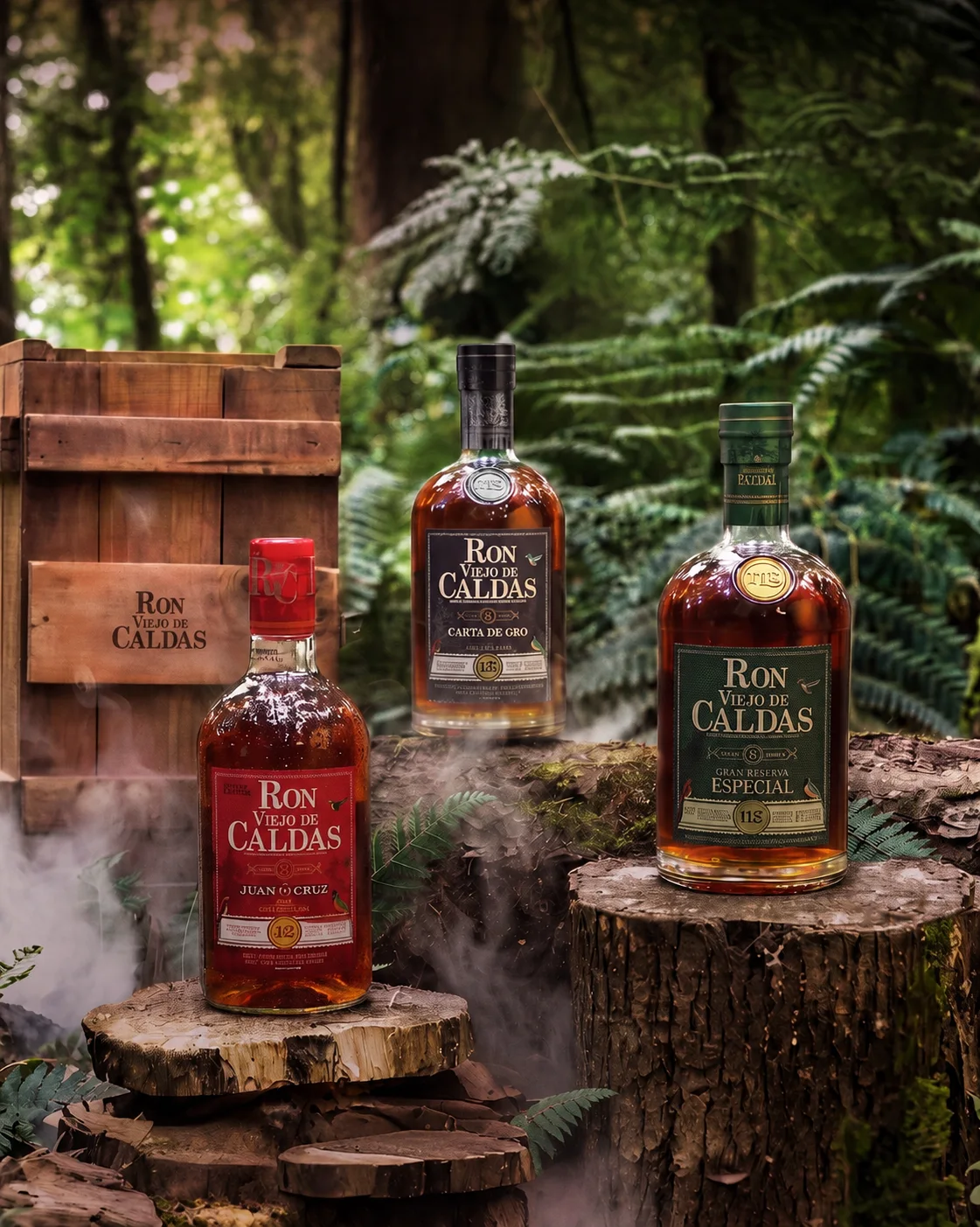
At more than 7,200 feet above sea level, the air grows cooler, clouds drift through the mountains, and the landscape of Colombia’s central Andes takes on a character all its own. Here, in the highlands of Caldas, Ron Viejo de Caldas has built its identity around a distinctive idea: that the place where a rum rests is part of its story.
But altitude is more than a number on a map. It is an invitation to look closer at the relationship between nature, wood, time, and the people who bring them together.
A Spirit Rooted in the Mountains
The story begins in Manizales, a city shaped by the steep slopes of the Colombian Andes and the landscapes of the Caldas region. In 1928, the formula for Ron Viejo de Caldas was developed by Ramón Badía, a Cuban technician of Catalan origin working with the local liquor industry. The spirit would go on to become one of Colombia’s recognized rum names, carrying a piece of its mountain homeland with it.
The setting remains central to the brand’s identity. According to the producer, its rums mature in Colombian white oak barrels at approximately 7,200 feet above sea level, in a highland environment associated with mountain forests and mist. The brand also highlights the natural water sources and forest landscapes of the region as part of its heritage.
These are not simply scenic details. They help explain the place from which the rum comes—and the environment in which its character develops.
What Happens Inside the Barrel?
A barrel may look still from the outside, but maturation is anything but motionless.
As rum rests in oak, the spirit interacts with the wood. Compounds are extracted, oxygen moves slowly through the barrel, and chemical reactions gradually influence aroma, flavor, and color. Notes associated with vanilla, spice, toasted wood, and other familiar characteristics of aged spirits can emerge through this complex exchange.
“A barrel is not merely a container; it becomes an active participant in the transformation taking place inside it.”
The process is shaped by several variables: the type and treatment of the oak, the barrel’s history and size, the spirit itself, and the surrounding temperature and humidity. Evaporation also plays a role, reducing the volume in the barrel over time—a natural part of maturation often known in the spirits trade as the “angel’s share.”
This is why the environment matters. Temperature and humidity affect how a spirit evolves and how much liquid is lost, while the wood determines many of the compounds available to interact with it. Altitude alone does not dictate the result; it belongs to a wider set of conditions that make each aging environment distinct.
For Ron Viejo de Caldas, the combination of Colombian white oak and high-altitude maturation is a defining part of its production story.
The Human Hand Behind the Tradition
Nature provides the setting, but craftsmanship gives the process direction.
In 1964, the company brought in Antonio Ruiz, a cooper from Barcelona, to begin building barrels at its Manizales facility. That detail offers a glimpse into the evolution of the rum’s production: a Colombian spirit shaped by its own landscape, while drawing on specialized knowledge of barrel-making.
Cooperage—the craft of making and preparing wooden barrels—is an essential part of spirits maturation. The wood, its construction, and its preparation influence the exchange between barrel and spirit. A barrel is not merely a container; it becomes an active participant in the transformation taking place inside it.
The history of Ron Viejo de Caldas is therefore not only a story of aging. It is also a story of people who developed, refined, and sustained the knowledge behind the process.
Time, Place, and Character
The idea behind high-altitude aging is compelling because it brings together elements that cannot be reduced to a single technique. There is the mountain environment, the Colombian white oak, the spirit resting within the barrel, and the experience required to guide it over time.
Each element matters, but none tells the whole story on its own. The final character of an aged rum emerges from their interaction—and from the decisions made along the way.
Ron Viejo de Caldas has made this relationship between landscape and maturation a central part of its identity. Its story invites us to consider rum not simply as a finished spirit, but as the outcome of a place, a material, a tradition, and time spent together.
In the Colombian Andes, the mountains do not age the rum by themselves. They provide the setting. The oak becomes the meeting point between wood and spirit. And the craft lies in understanding how these elements work together.
Some stories are measured in years. Others are understood through the places that shape them.
This is the altitude of time.