
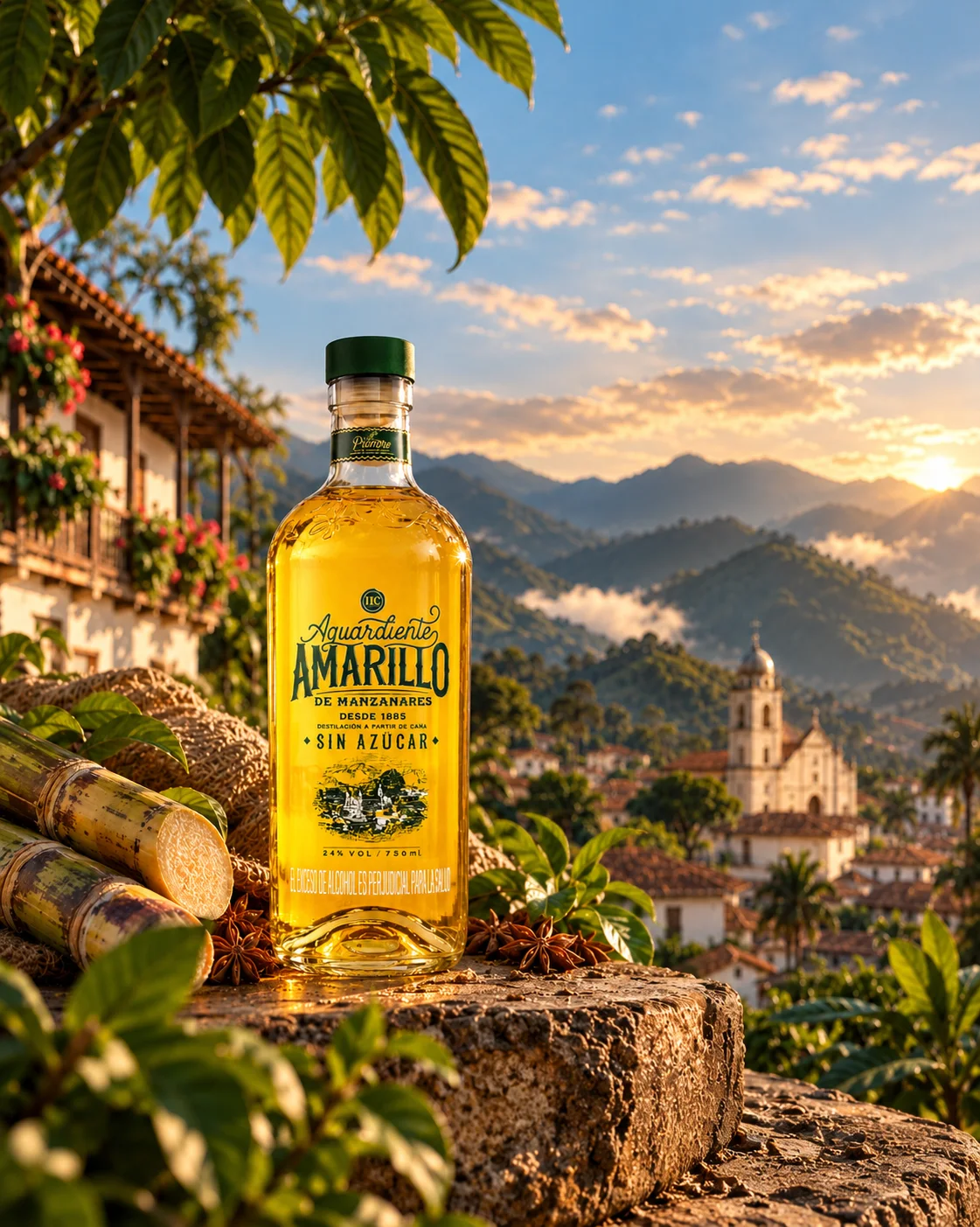
Long before its yellow bottle became recognizable beyond its hometown, Aguardiente Amarillo de Manzanares belonged to a very different world: a world of steep mountain paths, working mules, rural distillers, and small towns where the distance between a producer and a customer could be measured in hours on horseback.
Its story begins in Manzanares, a town in Colombia’s department of Caldas, where a spirit would become closely associated with the place that gave it its name. Traditionally traced to 1885, its origins connect a distinctive liquor with the agricultural life, ingenuity, and mountain culture of Colombia’s coffee region.
But to understand this aguardiente, it helps to begin with the town itself.
A Town Built Along the Mountain Roads
Manzanares took shape in the nineteenth century, during a period of migration and settlement that brought people from Antioquia and Tolima into the eastern mountains of what is now Caldas. Farmers established homes and cultivated the land, while traders and muleteers moved between settlements along demanding rural routes.
These were not landscapes designed for easy travel. Goods had to cross slopes, muddy tracks, and winding paths. The arriero—the muleteer who carried merchandise across the mountains—was an essential figure in this world, connecting farms, villages, markets, and people.
Manzanares became a place of passage as well as settlement. Its identity grew from agriculture, commerce, and the everyday resourcefulness required to make a living in the mountains.
It was in this setting that the story of Aguardiente Amarillo began.
Camilo Jiménez and the Yellow Liquor
The traditional history of Aguardiente Amarillo de Manzanares traces its formula to 1885 and to Camilo Jiménez, a local campesino remembered as one of the spirit’s early makers.
The details that survive give the story an unusually human scale. According to a tourism inventory published by the Government of Caldas, Jiménez distributed the liquor in barrels carried by a donkey named Panchita. The same account recalls the later regional distribution of the drink by Juan de Dios Echeverry, who oversaw production and sent it out across eastern Caldas using a train of 25 mules.
Before modern bottling, highways, and national distribution networks, a spirit’s reputation depended on people willing to carry it from one place to another. Every journey helped connect the producer to the communities that would come to know the drink.
“Panchita is more than a charming detail in the story. She represents a time when commerce depended on animals, local knowledge, and the physical effort of crossing the mountains. The liquor traveled not through an abstract supply chain, but through the landscape and the hands of the people who moved it.”
Three Ingredients, One Sense of Place
The traditional account of the aguardiente highlights three elements associated with its origins: caña gorobeta, anise cultivated on Cerro Guadalupe, and water from the source of the Santo Domingo River.
Each points toward a different part of the region’s character.
Sugarcane belongs to the agricultural history of Colombia, where the plant has long supported the production of panela and other cane-based products. Anise brings the aromatic character associated with aguardiente, while the references to Cerro Guadalupe and the Santo Domingo River root the drink in specific places around Manzanares.
Together, these details tell a story of local identity: a spirit remembered not simply by its flavor or color, but by the ingredients and landscapes associated with it.
The exact original formula and its production history should be distinguished from the broader cultural story. What matters here is that the brand’s identity has consistently been tied to its Manzanares origins and to the agricultural ingredients highlighted in its historical narrative.
Why Yellow?
Today, the color is part of the spirit’s unmistakable identity. But its history invites a question: what did that color mean when the liquor first appeared?
Some Colombian accounts suggest that the yellow hue was connected to the methods used in early artisanal production, when the equipment and techniques differed from those of modern distilleries. This explanation appears in journalistic accounts of the drink’s history, although it should not be treated as a fully established technical conclusion without more detailed production records.
Over time, whatever its original cause, the color became a defining feature. What might once have distinguished a locally made spirit from clearer alternatives now helps make it instantly recognizable.
The story is a reminder that a product’s identity is not always designed in a boardroom. Sometimes it emerges from the circumstances of its creation, survives through familiarity, and eventually becomes part of a region’s cultural memory.
From a Local Tradition to a Colombian Name
The aguardiente’s history did not remain confined to the town where it began. The formula became associated with the liquor industry of Caldas, and the Industria Licorera de Caldas later carried the name into a broader market.
The precise milestones of that transition deserve careful treatment: historical accounts distinguish between the formula’s traditional origin in 1885, the early development of liquor production in Caldas, and later stages of institutional production and distribution. Those events are related, but they are not necessarily the same event.
What is clear is that the drink’s identity has continued to draw on its place of origin. Even as its reach expanded, Manzanares remained central to the name and the story.
That connection is especially meaningful in a country where food and drink often preserve a sense of place. A familiar flavor can carry memories of a hometown, a family gathering, a local celebration, or a journey through the landscape that produced it.
A Spirit with a Sense of Belonging
Aguardiente Amarillo de Manzanares is more than a yellow spirit with a distinctive name. Its story brings together a nineteenth-century mountain town, the movement of settlers and muleteers, agricultural ingredients, and the resourcefulness of a rural producer whose name has endured in local memory.
The mountains are not merely a backdrop. They explain the routes that connected communities, the work required to move goods, and the close relationship between local production and regional identity.
Today, discovering this aguardiente means encountering a small piece of Colombia’s cultural geography. Its history begins not with a global ambition, but with a place, a formula, and the people who carried it beyond their own streets.
Some spirits tell their stories through age or the barrels in which they rest. This one begins with a town, a mule named Panchita, and a yellow liquor that found its way through the mountains of Caldas.
And sometimes, that is where the most memorable stories begin.